
Studio
Where the house makes things for me: songs, videos, voices, pictures and 3D prints. The heavy models run on a second machine in the house, so nothing is billed per song or per picture.

SongsA member writes the style and the lyrics, and the house makes the song.
It comes from an open-source music model on the second machine and is posted in Slack to play inline. A take that goes silent before its end is caught by its level and made again with the next seed, up to three takes.
Spatial mixesTakes a song apart and moves each part around the listener’s head.
It is mixed in 3D for headphones, from 368 directions measured on a dummy head, and each part has its own pitch, filters and echo; a two-minute song with twelve moving voices renders in about 15 seconds.
Music videosTurns a song into a video cut on its own beats.
Each cut lands on the last beat before its line starts, and every frame is drawn with sub-pixel moves so a slow pan does not shimmer.
Lyric videosA song’s words, on screen as it plays.
The words in moving 3D type, rendered in Blender, each line’s energy read from its section and its loudness. The timing is described next.
Lyrics timed on the singer’s voicePuts every sung word on screen as it is sung.
The song is split into its parts and the words are force-aligned onto the isolated vocal one sung line at a time, so one bad line cannot drag the rest, and a word the aligner is unsure of keeps the transcription’s time. Checked against the vocal’s own onsets on 194 words that start with a hard consonant, the median word is 36 milliseconds off and 92 percent are within a fifth of a second.
- 36 ms typical gap between a word and its sound
- 92% of words within a fifth of a second
- 194 words checked against the voice itself
Light showsGlowing tubes that move to a song.
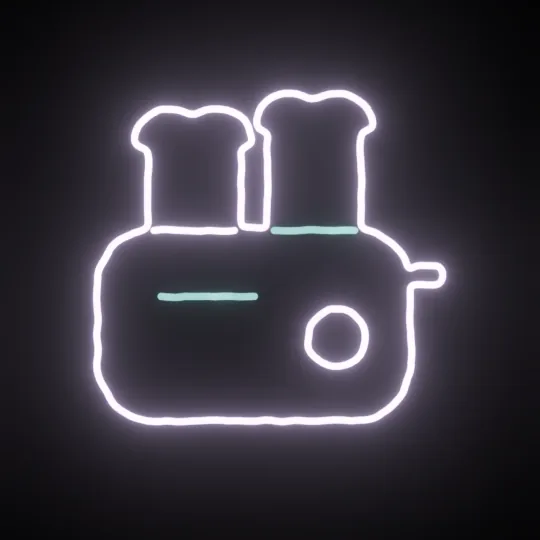
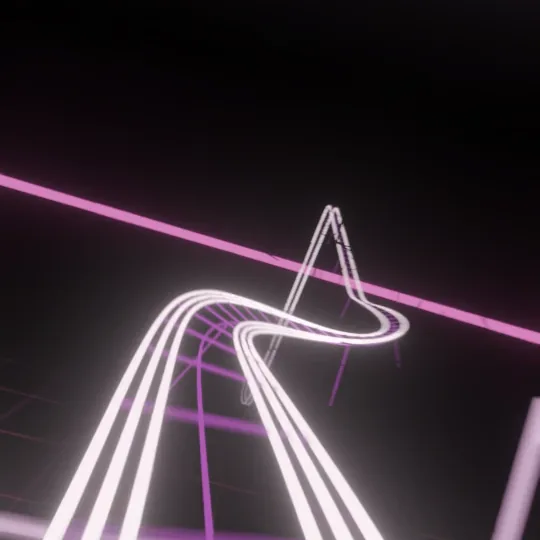
Glowing tubes that form pictures, morph on the beat and pulse with the music, with the song’s words in a band underneath; the tracing and the morphs are described next.
Light shows drawn in neon tubesDraws pictures in glowing tubes that change into each other on the beat.
A picture is traced into lines (a threshold, centrelines, a graph of the junctions, short spurs pruned), drawn at 5 levels of detail, from 16 to 96 strands, and laid on a shared pool of 64 strands of 24 points each. One picture morphs into the next by pairing strands with the Hungarian method, and every point is keyed frame by frame on the song’s own beat clock.
- 64 glowing strands in every picture
- 24 points along each strand
- 5 levels of detail, from 16 to 96 strands
Road-trip videosA camera walks a real street, timed to the song.
The street is built from real map data with the buildings at their heights; the camera finds the moment the view opens up by casting rays through a 1-metre grid of the city and times that reveal to the song’s drop.
The infinite zoomA chain of pictures, each painted around the one before, flown through.
The camera flies a smooth banking path and cuts at the first depth where the next opening fills the screen, and every picture is upscaled four times.
Voices made from a descriptionMakes a new voice from a few words describing it.
I describe a voice in words; one model reads a reference line in that voice, a second takes a speaker print from it, and a third reads every line of a story with that print and the line’s own direction (“hushed, with awe”), so the person stays the same while the acting follows the story. A separate speaker-recognition model scores the first and the twentieth line of one story 0.63 alike, against 0.06 to 0.21 between two different speakers, and a minute of narration takes 45 seconds to read.
- 3 models working together on every line
- 0.63 how alike its own first and twentieth lines score (two different people: 0.21 at most)
- 45 s to read a minute of story
A voice cloned from a recordingCopies a voice from any recording, and warns me when the room will spoil it.
From any recording the house keeps the best 10 to 20 seconds: 20-millisecond frames are sorted into speech and silence, long pauses are shortened, and the stretch with the most speech and the least clipping wins, taken from the driest part when the recording’s room changes. The room is measured in the pauses after words, because a clone carries its echo: close-mic podcasts read -41 and -47 dB, speeches in halls -23 to -27, and past -30 the tool warns. Cloned “close”, every line is read from the clip itself instead of acted, and it scores 0.67 against a held-out recording of the same speaker, against 0.50 acted.
- 10–20 s of speech is all it needs
- −30 dB of room echo, where it warns me
- 0.67 match to the real person's voice (0.50 when acted)
Story readingsStories read aloud, with the words on screen.
The voice is one I choose or one made for the story, and each line moves on screen the way it reads. A line the voice says wrong is respelled for the voice while the screen keeps the line as written; the voices are the two items above.
Spoken answersA member’s answer can be read aloud, in a voice of its own.
No two members sound alike. An answer can carry one of ten tones (warm, wry, urgent and so on), set either by the voice’s own speaking style or by measured shifts in pace and pitch, with effects and a room mixed after it to one loudness. It is off until I turn it on for a channel, because some voices are synthesized by a hosted service.
ImagesRenders the images the members need.
The renders run on the second machine, and the member chooses the model that fits the job. The tool refuses a combination of model and adapter that would silently drop the adapter, before it wastes a render.
- 3D objectsProps for the show’s set are made as 3D models and kept for reuse.
3D prints of real placesTurns a real place into a model I can print, buildings at their real heights.
The ground at its real elevation, the streets, the water and the buildings at their measured heights, with roofs fitted as flat, gable, hip or pyramid planes to 1-metre laser scans where a survey has them. The model is six watertight parts, each its own filament, every solid is checked the way the printer’s software will load it, and nothing narrower than 0.4 mm is kept.
- 6 printable parts, one per colour of filament
- 1 m laser scans the roofs are fitted to
- 0.4 mm the finest detail it keeps