
Media
My library of personal videos and public-domain films. It lives on an internal website the house built and runs for my own use, reachable only on my private network and installed on my phone like an app. The house prepares every film so I can watch it with good captions and go straight to the parts I want.
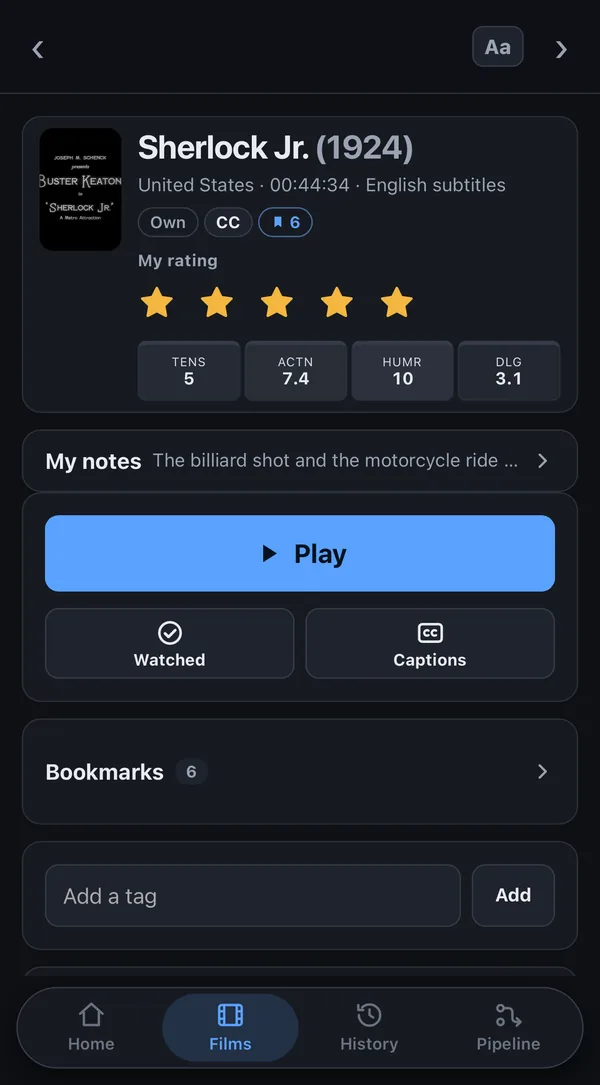
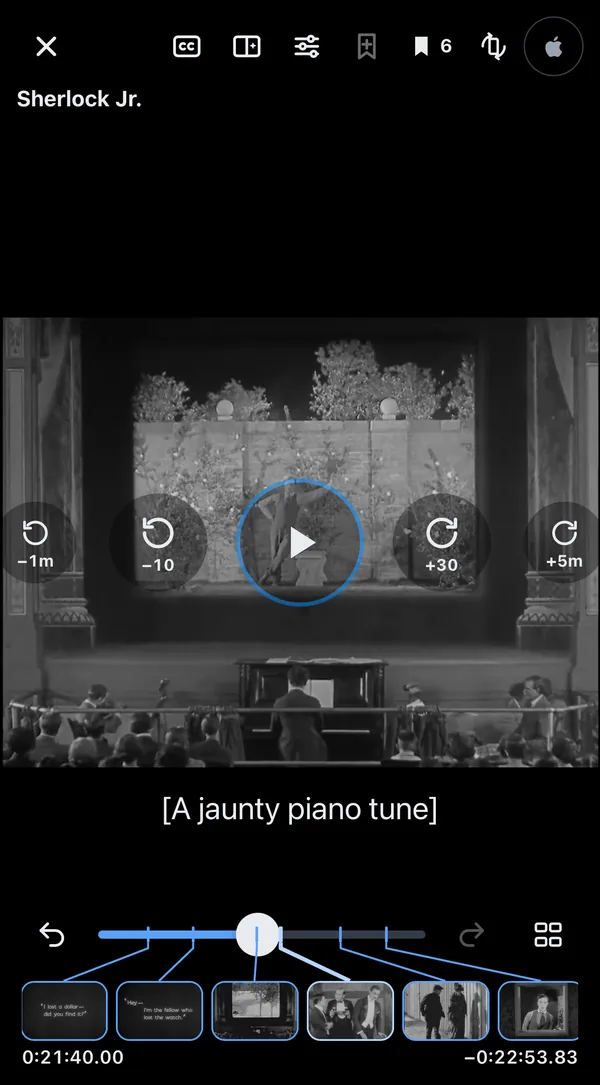
The playerStreams my library to my phone, with captions, bookmarks and ratings.
Every film arrives with locally made captions, a track of sound captions, bookmarks and a rating of what each part of it is about, all described below; subtitles burned into the picture are found by on-device text recognition so they can be hidden under mine.
Captions made at homeSubtitles and sound captions, made on my own machine.
An open-source speech model (Whisper large-v3) on the second machine’s GPU writes the subtitles, about 9.4 seconds per minute of film, after a separate voice-activity model has cut out the speech, which keeps a long film’s subtitles in sync. A second track captions sounds with the classifier built into the operating system (303 kinds of sound), only in gaps in the dialogue, and a blind check by ear on 30 clips is what tunes it.
- 9.4 s to caption a minute of film
- 303 kinds of sound it can caption
- 30 clips checked blind, by ear
A bookmark agent that watches every filmWatches every film and marks the moments worth going back to.
The house cuts each film into contact sheets, a frame every 30 seconds, and a Claude model reads every sheet, lists the moments worth marking, then asks for a close-up sheet around each one, a frame every 5 seconds, and marks the first frame where the moment shows. The tool prints the measured time of every frame, so each mark lands on the second the moment begins: a 93-minute film becomes 187 frames in 8.4 seconds.
- 187 frames read from a 93-minute film
- 30 s between frames on the first pass
- 5 s between frames on the close-up pass
Scene ratings, and a model of my tasteGrades what each part of a film is about, and predicts how much I will like it.
Every film is graded on a fixed set of dimensions (say tension, action, humour and dialogue), on five levels from none to extreme, as a whole and for every 30-second stretch, from the frames and the captions rather than from a plot summary. A ridge regression fitted to my star ratings turns the grades into a prediction of how much I will like a film; tested by hiding each rated film in turn, it misses my own rating by 0.91 stars on average over 85 films, against 1.07 if it just guessed my average.
- 0.91 stars off my own rating, on average
- 1.07 stars off if it just guessed my average
- 85 of my rated films it was tested on
RemasteringSharpens old films.
An open-source video upscaling model, ported to the second machine’s graphics chip, sharpens an old film frame by frame; the port took it from 7.5 seconds a frame to about 2.5.
- My own videosA video link I send is downloaded into my media library with its full details, private when I say so.