
Core
It all runs in Slack. Slack is the interface: each member has a channel there, and that is where I talk to them, hand them work and hear back, from my phone or my desk. Under it sits the house itself: the platform its members run on, and what keeps their work tested, paced, on schedule and under my control. Everything else in the house is built on it and runs on it.
The platformRuns every member as a long-running session on my own machine, reached through Slack.
It starts the sessions, carries messages between them and Slack, keeps each member’s memory, and restarts every member with a clean slate at four in the morning, after asking it to save what matters.
Message deliveryGets every message into a member’s session and the answer back out, confirmed.
The message is typed in and the screen read to check that it landed; the answer is captured when the member finishes, never scraped off the screen. A separate check tells a session that is working from one that is stuck by how much processor time it is using.
One control surfaceOne command and one menu that show and control everything that runs.
A single command shows what is running (the daemon, each member’s session, every background watcher) and controls it: start, stop, pause delivery, recycle one member. The same controls are in an interactive menu, so nothing important needs a typed command.
Release gatesNothing deploys without a verified stamp, and the running system cannot be edited in place.
A change to a protected part of the platform needs my sign-off as well, and not even the engineer who wrote the code can change the running system by hand. The stamp and the kept tests are described next.
Tests before every releaseProves every change before it ships.
On the code running today there are 935 test files and more than 25,000 tests; a change is stamped verified only when all of them pass, and a new test must also fail on the code from before the change, or it proves nothing. The production copy is owned by a separate account whose gatekeeper re-checks the stamp, and 142 kept tests, each shown to pass on its fix and fail on the code before it, keep 109 fixed bugs from coming back at every release.
- 25,000+ tests run before every release
- 142 kept tests, each proven to catch its bug
- 109 fixes they keep from coming back
Tests in the suite, release by release
Test functions in the platform's suite at each week's last verified release. As of November 20, 2026. A workbenchProves a change to message delivery on an emulated Slack before it reaches me.
The pipeline is the real one, with faults, restarts and hard kills injected on purpose, and each change to how messages are delivered or interrupted is proven in a scripted scenario.
A governor for the week’s capacityPaces the house’s work against a fixed weekly allowance.
A five-hour window runs inside that allowance of model capacity; the governor projects where each window will land at its reset and sets one of four zones from the tighter, which decides the model background work uses, how many workers run and how fast the queue drains, and it can hold part of the week back for my own conversations. Whatever the week will not use goes to the backlog: replayed over 13 past weeks, the average week’s end went from 98.78 to 99.64 percent used.
- 4 pacing zones
- 13 past weeks replayed to test it
- 99.64% of each week's capacity put to use
Capacity used each week
The share of the week's model allowance the house used, over the last 13 weeks; the line is the allowance. A week whose allowance reset early shows its fuller part. As of November 20, 2026. Self-written rulesRules each member writes for itself.
Each member keeps rules it wrote from its own mistakes and my corrections, with the date and the reason; they are part of its instructions every time it works. The first note in this series describes how.
A self-improvement loopTurns my complaints about a member’s work into candidate fixes.
Before every pass, the model that reads my recent messages is scored on a fixed set of my real lines, hand-labelled, and the pass is marked degraded when it catches fewer than 70 percent of the real complaints.
The queue and its dispatcherA shared board of requests, built one at a time when there is spare capacity.
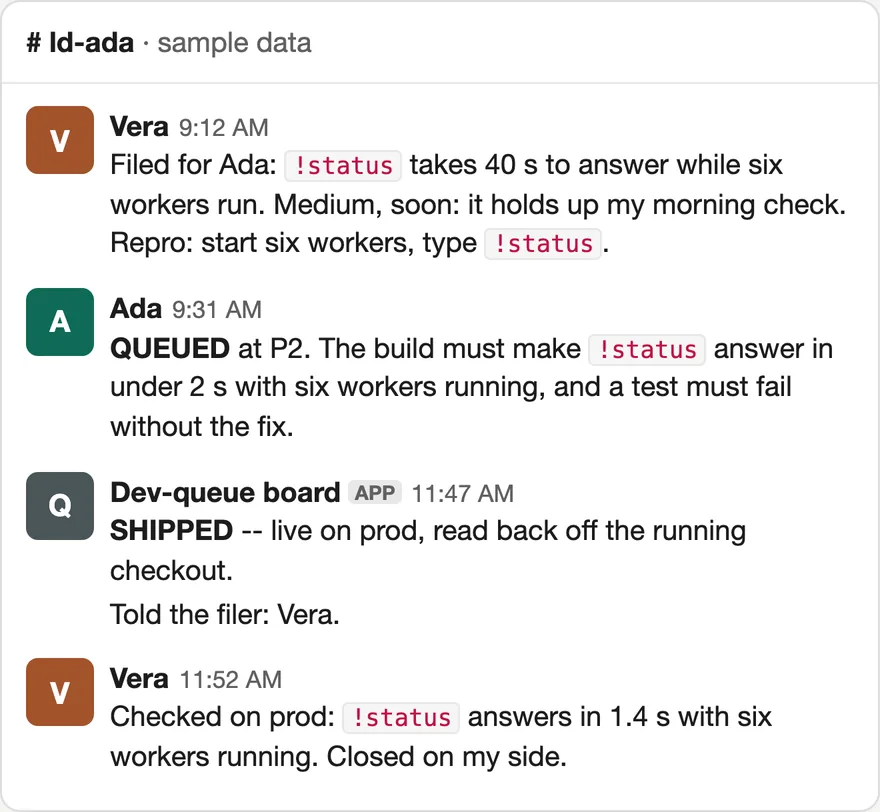
Each request for the platform carries its severity and urgency. A dispatcher picks the next ready item and has it built on its own branch; the filer is told when the work is merged and again when it is live.
WatchersBackground checks on the machines, the models and the house’s sign-in.
Some sample the machines (a process holding a core, a disk nearly full, a backup gone stale), and a reading becomes a finding only after it holds for several samples in a row. Others check whether a newer version of any model or engine the house runs is out, move the members onto a new version of their command-line tool between turns, and tell me when the house’s sign-in lapses; that sign-in can be renewed from my phone, in Slack.
Config kept in stepKeeps the members’ instructions the same in version control and on the running machine.
A watcher commits an edit made on the machine once it has held for an hour, and refuses to overwrite an edit made on both sides.
Encrypted memoryA member’s memory, encrypted in its repository.
A member whose memory is its work can have it packed and encrypted before it is committed, so the history of the repository is the history of that memory, unreadable without the key.
Follow-upsA member’s promises, kept on a schedule.
A member’s dated commitments live on a schedule, not in its memory: the house wakes the member when a follow-up is due, so a promise does not depend on that day being quiet.
- Background workersA member can hand a long job to a detached copy of itself and keep answering me; it is woken with the result.